
Solutions
Open Badges
•7 min readUnderstand Open Badges 3.0, the latest global standard for digital credentials built on W3C Verifiable Credentials. Learn how it enables secure, portable, and interoperable digital badges for education and professional learning.

Khushi Bhatia
Updated on May 05, 2026
In this article
Ready to automate?
Join thousands of organizations using Certopus to issue verifiable digital credentials.
Get Started FreeIntroduction
Digital badges and digital credentials are no longer “extra”. Learners want proof they can carry; employers want faster verification; education providers want credentials that don’t get locked inside one platform. Open Badges 3.0 answers that need by defining a shared, interoperable way to package an achievement claim so it can be verified and shared across systems.
What are Open Badges 3.0
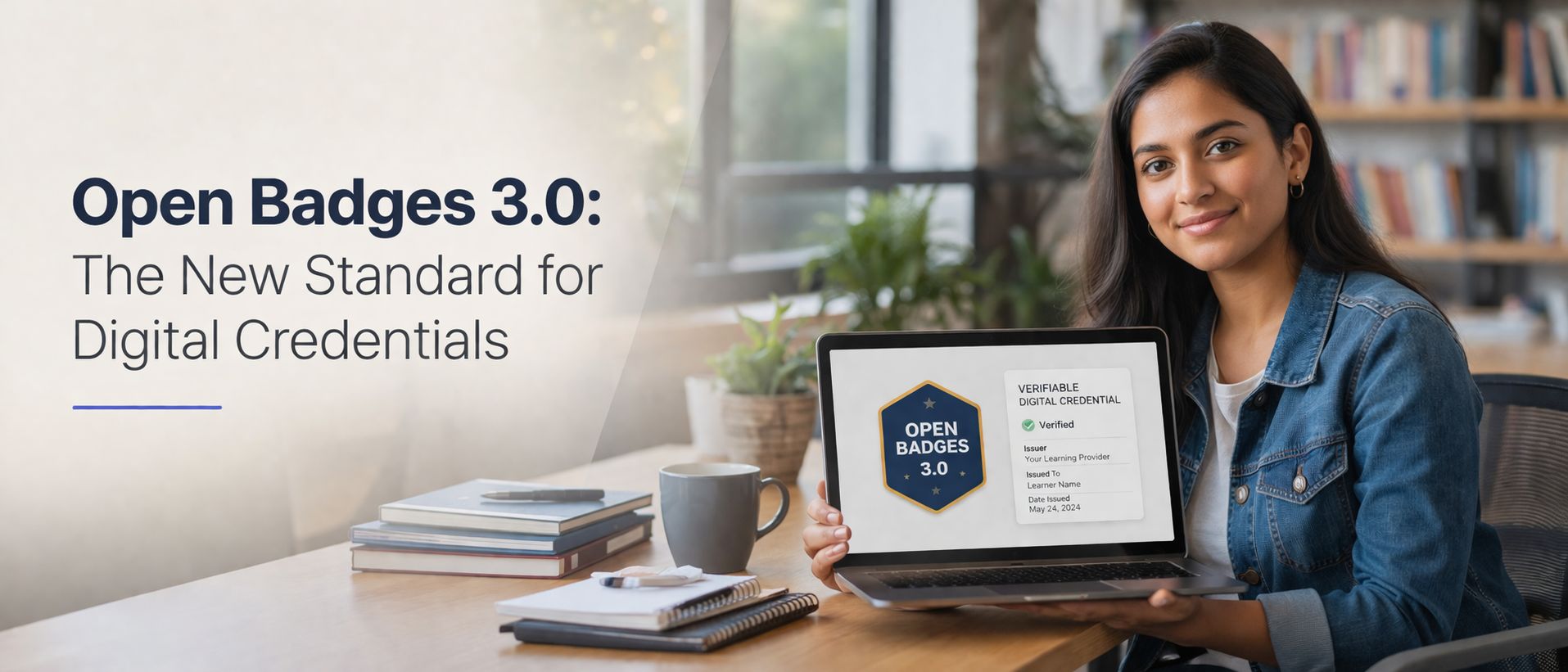
Open Badges is a global, open standard for digital badges, not a specific product or vendor. A badge following the standard is intended to be verifiable, portable, and packed with information about skills and achievements.
Open Badges 3.0 is the newest major version of that standard, maintained by 1EdTech Consortium (formerly IMS Global Learning Consortium). It was publicly released after community approval and is positioned as a step forward in security, learner ownership, and interoperability.
The biggest idea to remember: in 3.0, an Open Badges “Assertion” is also a Verifiable Credential (VC).
The standards behind Open Badge 3.0
.jpg)
Standard behind Open Badge 3.0
Open Badges 3.0 deliberately aligns with the World Wide Web Consortium Verifiable Credentials Data Model (VCDM). The Open Badges 3.0 specification adopts VCDM v2.0 conventions (and notes compatibility with the wider credential ecosystem that still includes VCDM v1.1).
Why this matters: VCDM 2.0 is a W3C Recommendation (15 May 2025) that defines a three-party exchange model: issuer, holder, verifier, and a common way to express claims so they are machine-verifiable and resilient to tampering.
W3C also published security specifications (for example, securing credentials with JOSE/COSE and selective disclosure patterns). That gives Open Badge 3.0 implementers standardised options for digital signature, encryption, and privacy-aware exchange.
Anatomy of an Open Badge 3.0 credential
Think of an Open Badge 3.0 credential as a structured claim + cryptographic proof:
- What was achieved: the specification focuses on the Defined Achievement Claim and Skill Claim use cases.
- What it means: metadata about criteria, dates, issuer, and earner, and it can include evidence that supports the claim.
- Why it’s trustworthy: cryptographic proofs/signatures so a verifier can validate authenticity.
If you’re coming from Open Badges 2.x, one useful comparison is “packaging”. Open Badges 2.0 describes packaging accomplishment data and embedding it into portable image files (“baking”), along with resources for validation.
Open Badges 3.0 keeps badge-style recognition, but upgrades the underlying data model so an Assertion is also a verifiable credential. The specification explicitly notes that badges issued under 3.0 won’t be conformant with all existing 2.x data model requirements.
Operationally, the Open Badges 3.0 conformance/certification guide describes verification procedures and defines an API for exchanging badge information.
What Open Badges 3.0 enables for higher learning and professional skills
.jpeg)
Built for Higher learning and professional skills
Open Badges 3.0 is built for lifelong learning: recognise learning “any time, anywhere” and make it easier to prove across contexts with interoperable, verifiable credential files.
That’s useful for continuing education and adult ed, professional development courses online, and a professional development course online that issues an instantly verifiable credential, especially as online learning and continuing learning become the default for many working adults.
A learner might stack education courses (study skills, web accessibility, digital media education, teaching resources) and keep them in a digital portfolio. Open Badges are designed to sit alongside traditional qualifications and professional accreditation, rather than replace them.
When you need a broader record, Open Badges 3.0 works with the Comprehensive Learner Record (CLR) standard: many achievement credentials can be bundled into a signed record, while each component credential remains verifiable, and the wrapper is verifiable too.
Because this is a standard (not a single platform), it supports many institution types and search intents, whether someone is looking up Temple University continuing education, researching an online university like Western Governors University, or searching “Arizona State University continuing education online classes” from Arizona State University.
Achievements outside traditional transcripts can be recognised too: student leader programs, community engagement, and skills gained in programmes like Temple football.
Verification, privacy, and the “it just works” experience
.jpeg)
Verification, privacy, and the “it just works” experience
A modern credentialing system is not only about the badge; it’s also about identity, privacy, and user experience.
From a trust perspective, Open Badges 3.0 leans on VC conventions: verifiers can validate cryptographic proofs and read standardised metadata instead of relying on screenshots or manual paperwork.
From a privacy and security perspective, W3C frames verifiable credential standards as cryptographically secure and privacy-respecting, with defined mechanisms for signing and securing credentials and presentations.
This is where terms like digital identity, digital identification, data privacy, privacy and data protection, data security, secure browsing, private browser, safe browser, and encrypt the message become more than buzzwords; they’re concrete operational choices.
From an “it just works” perspective, learners need simple journeys: verify email address, check the email, open email, sign in to my email account, log into email account, add email account, and get the badge link without friction. Issuers also need a support account, support email, and clear email template workflows, especially when credentials are shared via QR codes at events or “open signage” around a campus and training venue.
If you’re building in-house, you’ll run into practical needs like API documentation, identity verification use cases, and create digital signature workflows (make a digital signature, generate digital signature, create auto signature) tied to single sign-on and student information systems. Badge Connect style APIs in this ecosystem use OAuth 2.0 for identity-management integration.
Certopus and Open Badges 3.0
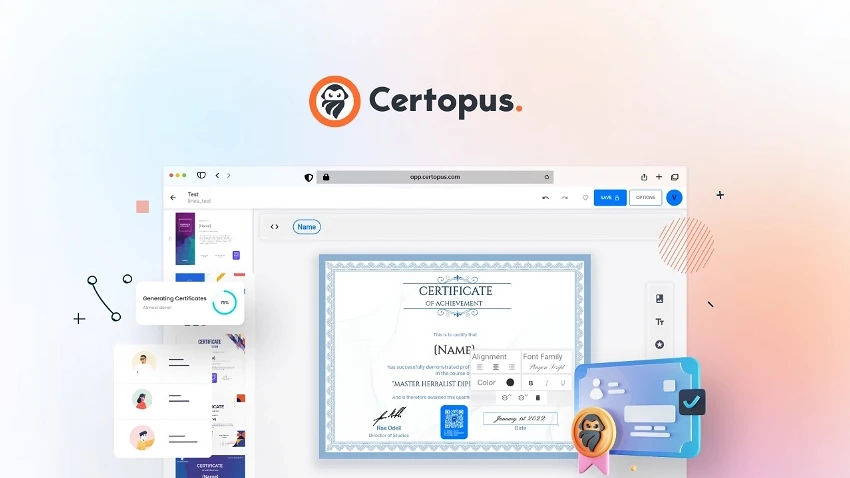
Certopus is positioned as a digital credentials platform that lets organisations design and issue Openbadges & W3C VC-compliant digital badges, alongside verifiable certificates and micro-credentials.
Certopus
If you’re comparing digital badge platforms, you’ll likely see Credly by Pearson described as an end-to-end solution for creating, issuing, and managing digital credentials, with a large network of credential issuers and earners.
The practical question is always the same: which credentialing platform helps your programme issue trustworthy credentials, keep brand guidelines consistent, support learner-controlled portability (including learner-initiated transfers of credentials), and preserve privacy and verification end-to-end.
Need more information?
Schedule a demo to learn more about Certopus for your business use case, or if you have any questions, don't hesitate to contact us. We would be delighted to assist you. Finally, if you're on social media, follow us to remain informed about our latest developments and learn more about digital credentials like certificates, badges, and micro-credentials.
Ready to issue verifiable credentials?
Book a personalized demo with our founder to streamline your digital credentialing workflow.

Frequently Asked Questions
No. It’s a standard. You can implement it yourself or use a certified or compatible platform.
Open Badges 2.0 packages accomplishment data and supports embedding it into portable image files, while Open Badges 3.0 adopts W3C Verifiable Credentials conventions. Badges issued under 3.0 are not fully compatible with the older 2.x data model.
Verification works using the badge’s metadata along with cryptographic proofs and digital signatures, following Open Badges 3.0 and W3C Verifiable Credentials security standards.
Yes. Open Badges can be included in a Comprehensive Learner Record (CLR), where both the individual credentials and the overall record are verifiable.
No. Membership is not required to use the standard, although certification programs and additional resources are available for members.
Yes. Open Badges can be shared as links or files, posted on websites, included in job applications, shared on social platforms, or stored in digital wallets for easy access and verification.