
Solutions
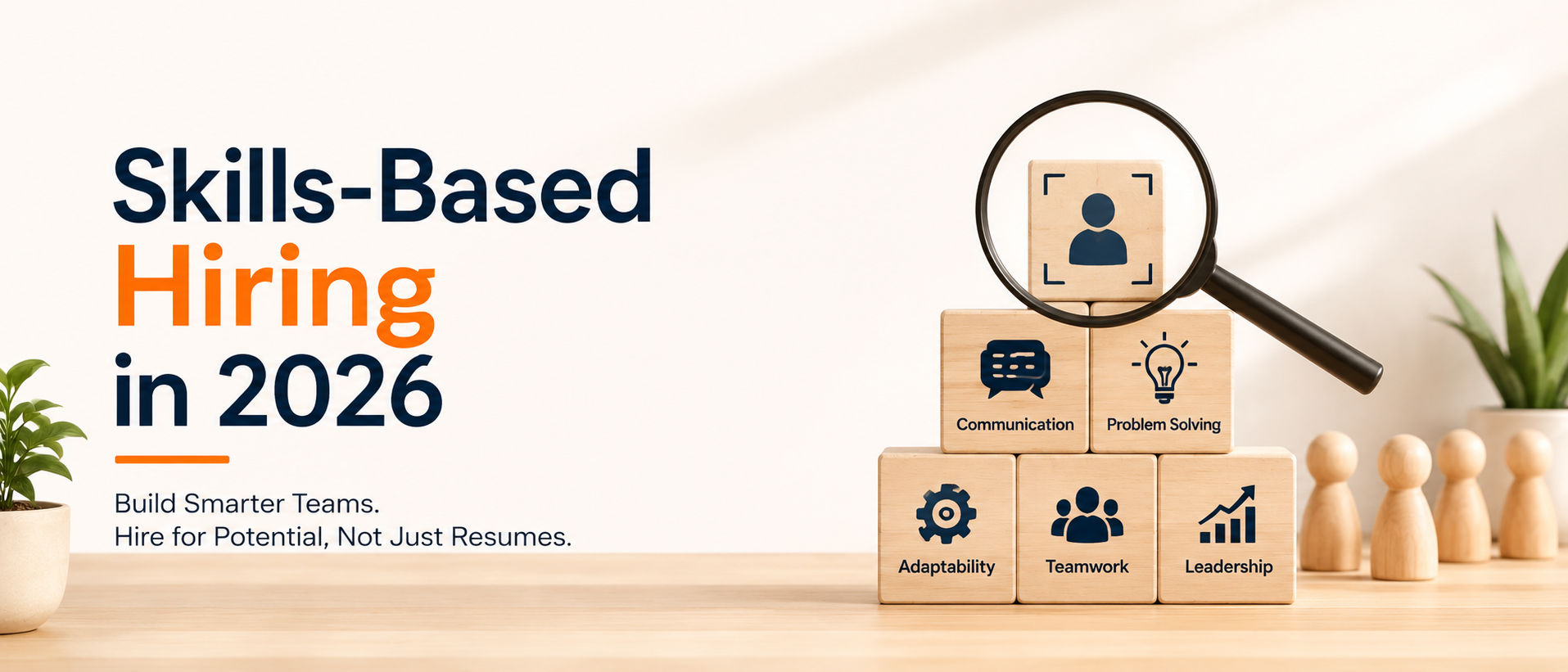
skills-based hiring
•6 min readExplore how skills-based hiring is changing recruitment and how digital credentials help employers.

Khushi Bhatia
Updated on Aug 24, 2026
In this article
Ready to automate?
Join thousands of organizations using Certopus to issue verifiable digital credentials.
Get Started FreeIntroduction
The standard, text-heavy resume is officially broken. For decades, a polished two-page PDF was your golden ticket into the interview room. But by 2026, a massive shift in how companies source, evaluate, and retain talent has turned the hiring world upside down.
With generative AI capable of writing flawless, keyword-optimized resumes in seconds, hiring managers are drowning in identical-looking applicant pools. Self-reported skills on a page no longer carry weight.
Today, forward-thinking organizations are dropping rigid degree filters and moving toward skills-based hiring. Taking center stage in this evolution are tamper-proof digital credentials, video-first portfolios, and dynamic talent discovery networks. Here is a deep look into how this modern ecosystem works and how it affects both employers and job seekers.
What caused the collapse of traditional resumes?
The downfall of the resume didn't happen overnight; it was accelerated by three major structural failures in traditional recruiting:
- The AI-Generated Resume Flood: Because anyone can use AI to build a perfectly tailored resume for any job description, applicant tracking systems (ATS) are overwhelmed. Keyword matching has become an unreliable metric.
- The Traditional Degree Gap: A university degree proves a candidate sat through four years of lectures, but it rarely guarantees they possess the niche, real-time technical or soft skills needed for immediate productivity.
- High Attrition from Bad Hiring: According to real-world HR data, recruitment processes built around self-reported profiles lead to higher turnover. Practical capability beats academic prestige when predicting on-the-job success.
What skills are employers looking for in 2026?
As static job roles dissolve into more fluid, project-based tasks, employers have completely overhauled what they look for in a candidate. The most in-demand capabilities in 2026 are broken down into two distinct areas:
1. Technical Capabilities & Dynamic Tooling
- AI-Workflow Integration: Employers no longer just look for "software engineers" or "marketers." They want professionals who know how to co-pilot daily workflows using advanced LLMs, prompt engineering, and automated agents.
- Data Literacy & Security: Every role now touches automated data dashboards. The ability to interpret analytics securely while adhering to modern privacy compliance is a top priority.
- Cryptographic & Verifiable Proof: Showing a project portfolio with cryptographic authentication is highly valued, particularly in tech, finance, and operations.
2. Adaptable Human Skills (The New Hard Skills)
- Applied Problem Solving: In a market where repetitive tasks are handled by software, humans are hired to solve multi-layered, unexpected exceptions.
- Cross-Functional Communication: The ability to explain complex technological pipelines to non-technical stakeholders or clients.
- Continuous Reskilling: Proving that you can unlearn old systems and master an entirely new software suite within weeks.
How do digital credentials prove actual skills?
When an employer can no longer trust text on a paper profile, they look for a trusted primary source. This is where digital micro-credentials and smart badges bridge the trust gap.
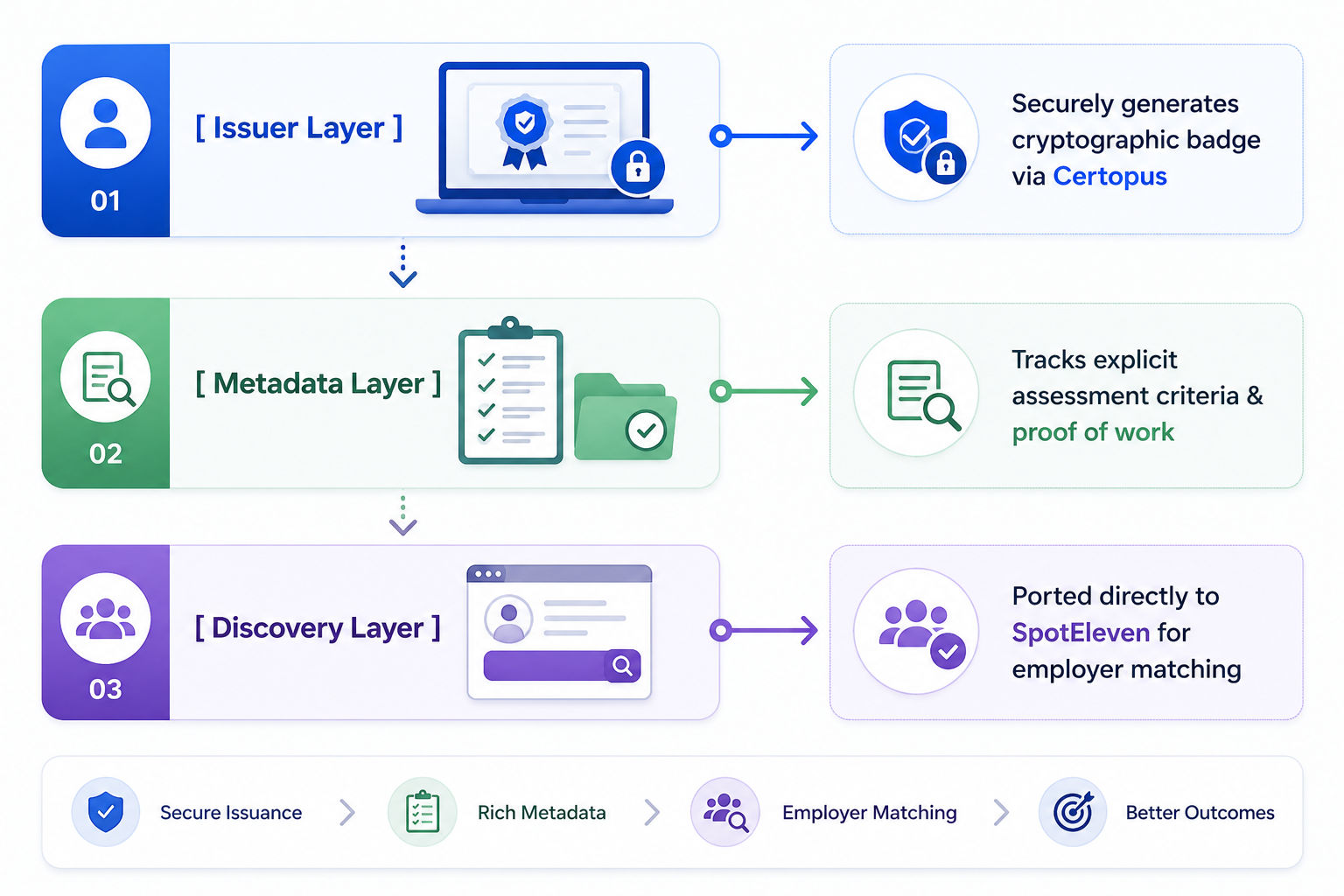
Instead of a vague line item like "Proficient in Python," modern professionals display cryptographic digital badges issued through specialized platforms like Certopus. These digital assets are not mere graphic elements; they are backed by the global W3C Verifiable Credentials and Open Badges 3.0 standards.
When a recruiter clicks on a badge issued via Certopus, they see embedded immutable metadata:
- Who issued the credential (e.g., an accredited institution, tech vendor, or enterprise training group).
- The explicit completion criteria required to earn it.
- The specific evidence or project link showing the actual work the candidate submitted.
This tamper-proof data layer eliminates the need for lengthy background checks and initial screening tests, cutting hiring cycles from weeks down to days.
Humanizing the Data: The Certopus x SpotEleven Ecosystem
While secure data is essential, a string of cryptographic code doesn't capture the full human element of an ideal team member. Recognizing this, a strategic integration between Certopus and SpotEleven has established a highly efficient career and recruitment pipeline.
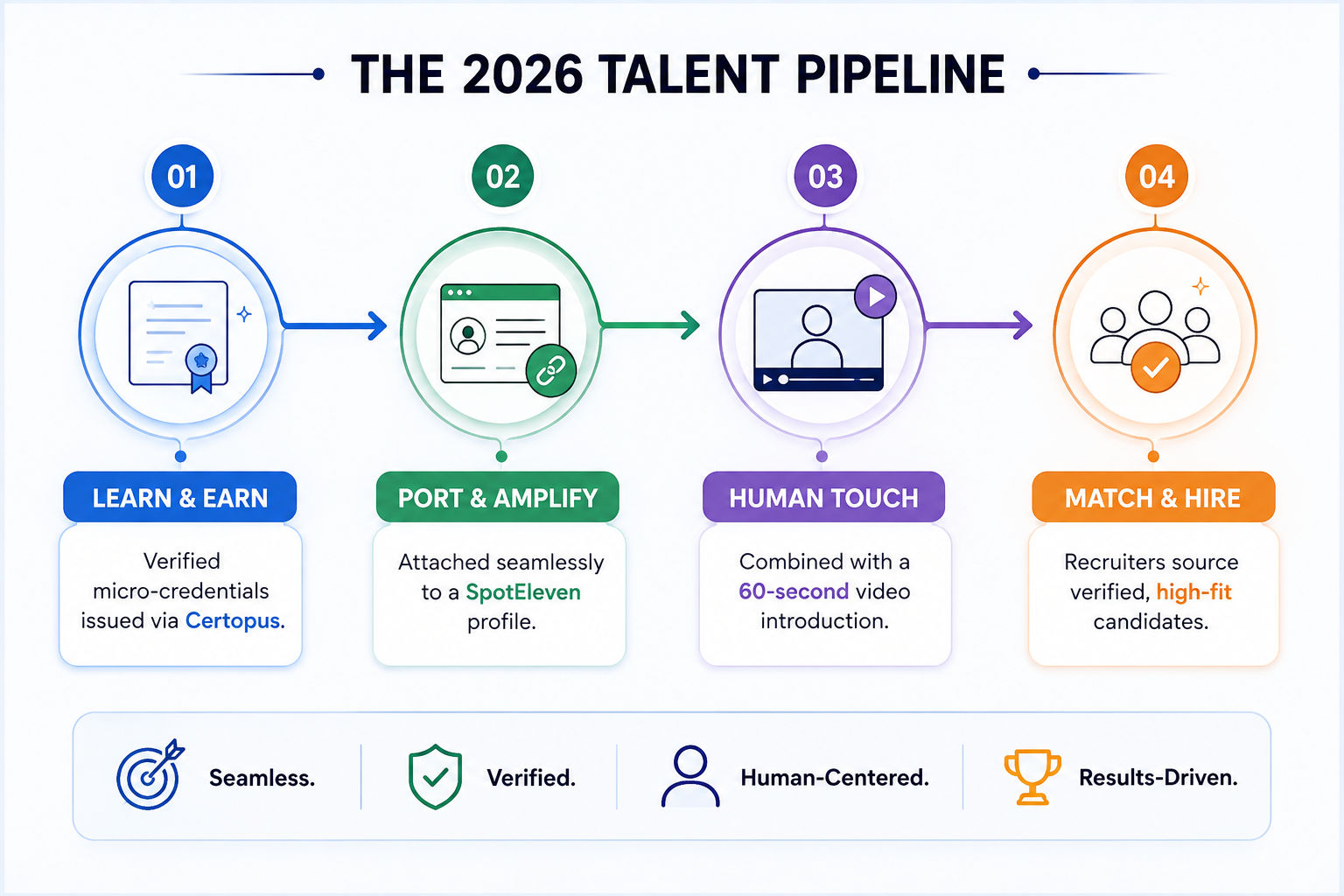
Through this unified ecosystem, a learner earns an automated, high-fidelity micro-credential from a course provider using Certopus. Instead of letting that credential sit quietly in an email inbox, it links into their profile on SpotEleven—a human-centric, video-first talent platform.
On SpotEleven, the candidate's verifiable tech stack sits alongside a 60-second video introduction. This approach allows hiring managers to immediately evaluate communication skills, cultural alignment, and technical expertise in one unified view. By replacing keyword matching algorithms with verified credentials and curated talent discovery, job seekers using this framework experience a 3x increase in interview callbacks.
How to transition to skills-based hiring
Whether you are building a team or navigating your professional journey, adapting to this ecosystem requires an intentional adjustment in strategy:
For Employers and HR Leaders
- Shift to Skills Taxonomies: Break down complex job roles into explicit micro-competencies. Define the exact technical requirements needed for each task.
- Utilize Discovery Networks: Pivot away from broad job boards that attract unverified applications. Leverage platforms like SpotEleven to engage with candidates whose skills are pre-verified through trusted platforms.
For Professionals and Learners
- Build Stackable Portfolios: Focus on earning micro-credentials that carry a digital verification layer. A collection of verified badges across specialized disciplines tells a compelling story of continuous growth.
- Embrace Video Authenticity: Do not hide behind standard text formats. Claim your professional identity on SpotEleven and introduce your unique background, approach, and personality through short-form video pitches.
Frequently Asked Questions (FAQ)
Q: What is skills-based hiring? A: Skills-based hiring is a recruitment framework that evaluates candidates based on measured capabilities, practical test performance, and verified proof-of-work, rather than relying on university prestige or traditional job titles.
Q: Can digital badges genuinely replace a college degree? A: Yes, especially in rapidly evolving industries like technology, design, and digital operations. While degrees remain relevant for regulated professions, micro-credentials offer employers targeted proof of specialized skills that traditional academic curricula may not cover quickly enough.
Q: How do recruiters verify that a digital badge is real? A: Modern digital badges issued by platforms like Certopus include cryptographic signatures and structured metadata conforming to Open Badge criteria. Recruiters can instantly verify the issuer identity, badge criteria, and student proof with a single click.
Ready to issue verifiable credentials?
Book a personalized demo with our founder to streamline your digital credentialing workflow.

Frequently Asked Questions
Skills-based hiring is a recruitment framework that evaluates candidates based on measured capabilities, practical test performance, and verified proof-of-work, rather than relying on university prestige or traditional job titles.
Yes, especially in rapidly evolving industries like technology, design, and digital operations. While degrees remain relevant for regulated professions, micro-credentials offer employers targeted proof of specialized skills that traditional academic curricula may not cover quickly enough.
Modern digital badges issued by platforms like Certopus include cryptographic signatures and structured metadata conforming to Open Badge criteria. Recruiters can instantly verify the issuer identity, badge criteria, and student proof with a single click.