
Solutions
Article
•11 min readUpdated on
In this article
Ready to automate?
Join thousands of organizations using Certopus to issue verifiable digital credentials.
Get Started Freetitle: 'Microcredentials Meaning, Benefits & Future Explained' description: 'What are microcredentials? Learn their meaning, benefits, and future compared to degrees, certificates, and digital badges.' date: '2026-07-06' tags: ['microcredentials', 'digital badges', 'skills-based hiring', 'professional development', 'digital credentialing software', 'certificate and badge issuance'] image: 'https://ik.imagekit.io/gsctqmcl8/ChatGPT%20Image%20Jul%206,%202026,%2002_31_41%20PM.png' author: 'Khushi Bhatia' authorImage: 'https://ik.imagekit.io/yfetaruyc/kb_duLcRwueS8.png?tr=w-300'


Introduction
Job postings used to ask for a four-year degree without a second thought. Now a lot of them ask for "demonstrated proficiency" instead. That one change in wording says a lot about why microcredentials went from a niche EdTech term to something hiring managers actually look for.
This piece walks through what microcredentials actually are, why they've become such a big deal, how they compare to degrees and certificates, and where things are heading next. We'll also get into how a platform like Certopus fits into all of this, and how the Spot Eleven integration turns a completed course into something a hiring manager can verify in seconds.
What Are Microcredentials, Really?
If you're asking what are microcredentials, here's the short version: they're small, skill-specific recognitions, usually earned through a short course, a workshop, a bootcamp, or an on-the-job assessment, that confirm someone has mastered one particular thing.
Three things make a microcredential different from just... a certificate you print out:
- It's specific. It points to one skill or a tight cluster of skills, not a whole field of study.
- It's verifiable. There's a digital record of who earned it, when, and how — not just a claim on a resume.
- It's portable. You can drop it on LinkedIn, attach it to a resume, or store it in a digital wallet, and anyone can check it's real.
You'll see microcredentials show up as digital badges, verified certificates, or nano-degrees. Programs like Google's Career Certificate and the Google IT Support Professional Certificate helped push the format into the mainstream, proof that even entry-level roles are starting to care more about what you can prove than what your diploma says.
Why Microcredentials Matter Right Now
A few things are happening at once that make this more than a trend:
The job market is moving faster than curricula can. According to the World Economic Forum's Future of Jobs Report, a significant chunk of workers' core skills are expected to become outdated within just a few years, and skill gaps, not funding or regulation, are seen as the single biggest barrier to business transformation.
Employers care more about skills than pedigree. Job postings increasingly favor demonstrated technical and soft skills over degree titles. LinkedIn's hiring data has tracked a steady move away from degree requirements in favor of skills-based screening.
Digital transformation isn't slowing down. New tools and platforms show up faster than universities can build full programs around them.
Careers are longer and messier than they used to be. Multiple pivots across a career means continuing education isn't optional anymore, it's just part of working.
Hiring itself has changed. Recruiters search by skill now, not just by major or title.
Even governments have taken notice, the OECD has recorded well over a million microcredentials issued in the United States in a single recent year, which tells you this isn't a fringe idea anymore.
How Microcredentials Compare to Degrees, Certificates, and Badges
It helps to see these side by side rather than take anyone's word for it.
Microcredentials vs. Degrees
| Microcredential | Degree | |
|---|---|---|
| Duration | Hours to a few weeks | 2–4+ years |
| Focus | One skill | A broad field |
| Cost | Low to moderate | High |
| Recognition | Growing, employer-led | Long-established |
| Stackability | Easy to stack | Fixed structure |
Microcredentials vs. Traditional Certificates
| Microcredential | Traditional Certificate | |
|---|---|---|
| Verification | Digital, instant, tamper-proof | Often just paper or a PDF |
| Granularity | Narrow and specific | Can be fairly broad |
| Shareability | LinkedIn, wallets, links | Usually just a file |
Microcredentials vs. Digital Badges
| Microcredential | Digital Badge | |
|---|---|---|
| Relationship | The broader concept | Often the format it takes |
| Metadata | Includes assessment criteria | Includes issuer, criteria, evidence |
| Standard | N/A | Frequently Open Badges-compliant |
Microcredentials vs. Professional Certifications
| Microcredential | Professional Certification | |
|---|---|---|
| Issued by | Institution or platform | Usually an industry board |
| Renewal | Often one-time | Frequently needs renewal |
| Scope | One skill | Often role- or industry-wide |
Who Actually Benefits From This
- Students get to build job-ready skills alongside their formal education instead of waiting until after graduation.
- Professionals get a fast, affordable way to keep learning without putting a career on pause.
- Employers get a quicker read on someone's actual skills before hiring or promoting them.
- Universities find a new revenue stream in short, professional courses that don't require a full degree commitment.
- Training organizations get proof — real, checkable proof — that their programs work.
- Government programs get a scalable way to close skill gaps at a population level.
- Corporate L&D teams finally get something they can measure, instead of just tracking course completions.
Industries Already Using Microcredentials
Healthcare, cybersecurity, finance, IT, AI, marketing, education, manufacturing, retail, and government have all adopted microcredentials in some form, from clinical competency badges to short cybersecurity certifications to AI-literacy badges for marketing teams that didn't exist two years ago.
How the Whole Thing Actually Works
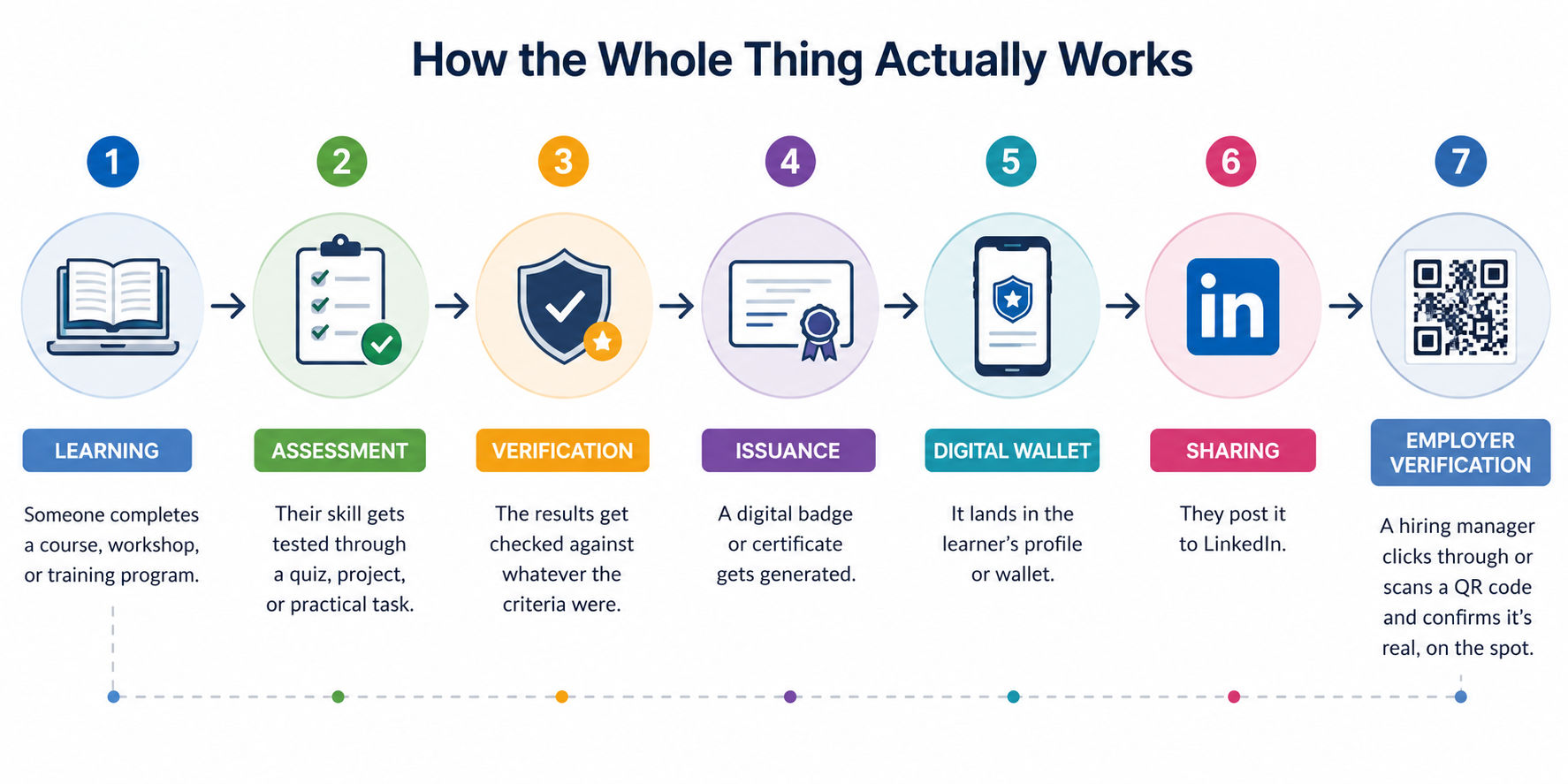
- Learning — someone completes a course, workshop, or training program.
- Assessment — their skill gets tested through a quiz, project, or practical task.
- Verification — the results get checked against whatever the criteria were.
- Issuance — a digital badge or certificate gets generated.
- Digital wallet — it lands in the learner's profile or wallet.
- Sharing — they post it to LinkedIn.
- Employer verification — a hiring manager clicks through or scans a QR code and confirms it's real, on the spot.
Why the "Digital" Part Actually Matters
A microcredential is only as good as the proof behind it. This is where a lot of "certificates" fall apart, anyone can make a PDF that says they finished something.
What actually makes a credential trustworthy:
- Verification you can check with a link, not a phone call
- Tamper-proof security so nobody can edit or fake it
- Blockchain-ready records for issuance that can't be quietly altered
- QR verification for a quick scan-and-confirm
- Open Badges compliance so it works across platforms
- Portability so it's usable everywhere the person wants to use it
Without that layer, a certificate is just a claim someone's making about themselves. With it, it's actual evidence.
Where Certopus Fits Into This
This is really the problem Certopus was built around, the gap between "someone finished the training" and "someone has a credential that anyone can trust and verify." For universities, training providers, and corporate L&D teams, Certopus handles:
- Issuing branded digital microcredentials and badges at scale, without doing it one by one
- Credential analytics — who opened it, who shared it, how often it's being verified
- API-based automation so credentials go out the moment someone qualifies, not whenever someone gets around to it
- Full white-labelling, so every credential reinforces the issuing organization's brand
- Instant verification links and QR codes employers can actually use
If your team is managing training programs, certifications, and learning tracks across departments, this is the piece that usually turns into a manual bottleneck and it's the piece Certopus is built to remove.
Real Results: TeenEagle 12,000+ Students with Certopus

TeenEagle, a UK-based global English language skills competition, ran into a familiar problem once it scaled past a few thousand participants a year: issuing credentials by hand across regional finalists, national winners, and general participants had turned into a full-time administrative headache, with no easy way for universities to verify any of it.
After integrating with Certopus Pathways, connecting directly into their LMS to auto-issue credentials based on competition results, TeenEagle issued 12,700+ verified credentials and generated 31,130+ visits to their white-labelled credential pages, turning every shared certificate into a source of traffic and credibility.
As their Director of Partnership put it, Certopus made the process more flexible, secure, and efficient, cutting down admin work while boosting the credibility of every credential issued.
It's a solid example of the "How Microcredentials Work" cycle in this article playing out at real scale, competition results feeding straight into verified, shareable credentials, with zero manual certificate-making.
The Spoteleven Integration: Credentials Built Right Into Hiring
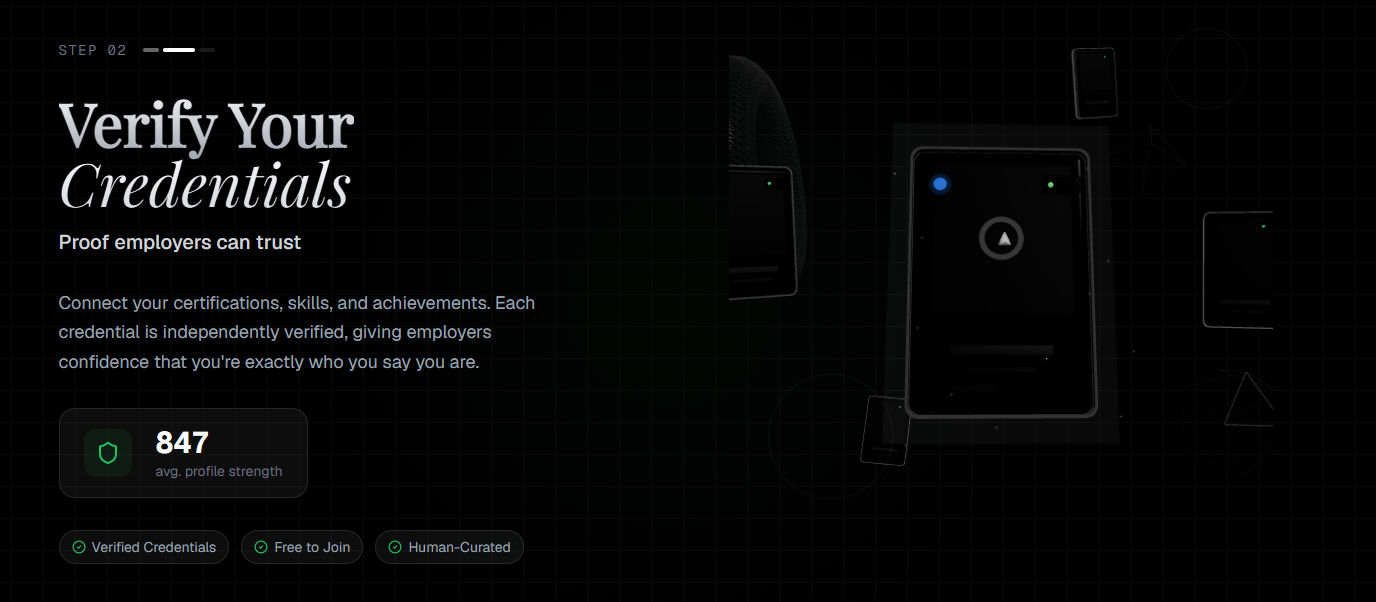
Certopus × Spoteleven
Spoteleven is a video-first hiring platform, it lets candidates show their personality, communication style, and real project work instead of getting filtered out by resume keywords. Paired with Certopus, every credential a candidate holds shows up as something an employer can actually verify, right there on their video profile.
Here's how it plays out in practice:
- Someone finishes a training, assessment, or event.
- Certopus automatically issues the microcredential or badge.
- They receive it right away.
- It shows up on their Spot Eleven profile and can be shared on LinkedIn
- An employer verifies it instantly, with no manual back-and-forth.
Why this actually matters for the business side:
- No manual work. Nobody's sitting there generating and emailing PDFs.
- More engaged learners. Getting something real and shareable the moment you finish tends to land better than a generic "congrats."
- Better completion rates. People are more likely to finish something when there's a visible, sharable reward at the end.
- Free brand visibility. Every credential someone shares carries your organization's name with it.
- Verification at the exact moment it matters — when an employer is looking at a candidate's profile, not weeks later during a background check.
This combination is especially useful for training providers and bootcamps whose learners go straight into job hunting. The credential isn't just a nice-to-have at that point — it's part of how they get hired.
Where Microcredentials Are Headed
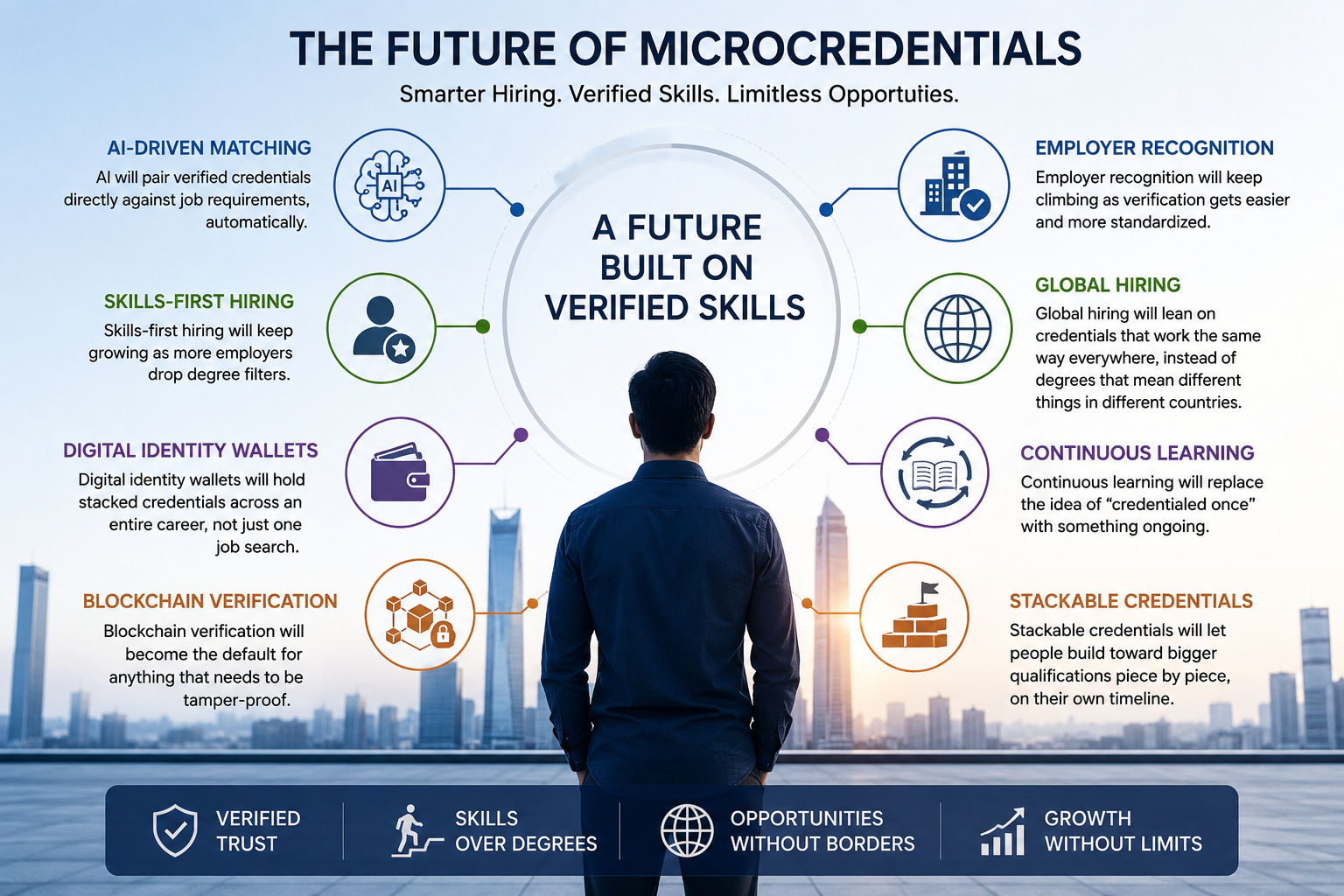
The future of microcredentials is tied pretty tightly to where hiring itself is going:
- AI-driven matching will start pairing verified credentials directly against job requirements, automatically.
- Skills-first hiring will keep growing as more employers drop degree filters.
- Digital identity wallets will hold someone's stacked credentials across an entire career, not just one job search.
- Blockchain verification will become the default for anything that needs to be tamper-proof.
- Employer recognition will keep climbing as verification gets easier and more standardized.
- Global hiring will lean on credentials that work the same way everywhere, instead of degrees that mean different things in different countries.
- Continuous learning will replace the idea of "credentialed once" with something ongoing.
- Stackable credentials will let people build toward bigger qualifications piece by piece, on their own timeline.
The short version of the microcredential future: it belongs to organizations that treat credentials as living, checkable data, not static files sitting in someone's downloads folder.
A Few Things Worth Getting Right
- Define the actual skill criteria before you issue anything, vague badges don't hold up.
- Use a platform with real verification built in, not just a design template.
- Make sharing genuinely easy, one click to LinkedIn, not five steps.
- Actually look at your completion and verification data. It'll tell you what's working.
- Tie every credential to a skill employers actually care about, not just something that looks nice on a certificate.
And a Few Mistakes to Skip
- Handing out badges with no clear assessment behind them
- Sticking with static image "certificates" that can't be verified
- Ignoring the data on who's actually finishing your courses
- Creating credentials that don't map to anything an employer recognizes
- Treating microcredentials as a marketing tactic instead of real proof of skill
Frequently Asked Questions
Ready to issue verifiable credentials?
Book a personalized demo with our founder to streamline your digital credentialing workflow.

Frequently Asked Questions
Not exactly. A digital badge is often just the format a microcredential takes — not every badge represents a rigorously assessed skill.
Certifications tend to be broader and industry-governed, often needing renewal. Microcredentials are narrower and tied to one specific skill.
Yes — they're one of the fastest ways to prove a new skill without committing to years of formal study.
Through embedded verification links, QR codes, or platforms like Spot Eleven that surface verified credentials right alongside a candidate's profile.