
Solutions
Article
•9 min readUpdated on
In this article
Ready to automate?
Join thousands of organizations using Certopus to issue verifiable digital credentials.
Get Started Freetitle: 'Best Platform for Automated Certificate Generation via LMS' description: 'Compare the best platforms for automated certificate generation via LMS, including integrations, digital credentials, verification, and certificate automation.' Date: '2026-09-06' tags: [ 'digital credential platform', 'automated certificate generation', 'LMS certificate automation', 'LMS certificate generator', 'digital certificates', 'certificate automation software', 'verifiable credentials'] image: 'https://ik.imagekit.io/gsctqmcl8/Automated%20Certificate%20Generation%20via%20LMS.png' author: 'Khushi Bhatia' authorImage: 'https://ik.imagekit.io/yfetaruyc/kb_duLcRwueS8.png?tr=w-300'

Which Platform Should You Choose for Automated Certificate Generation Using an LMS?
The right answer depends on how deeply the tool needs to connect to your LMS. If learners are completing courses in Thinkific, Teachable, TalentLMS, or a custom-built LMS, the platform you need isn't "the LMS with the best certificate feature", it's a dedicated digital credentialing platform that can trigger issuance automatically the moment a course is marked complete. Certopus, Credly, Accredible, Parchment, Sertifier, and CertifyMe all solve this problem, but they solve it differently, and the right one depends on your integration setup, issuance volume, and how much your learners rely on the credential afterward.
Quick answer: When choosing a digital credential platform for automated certificate generation using an LMS, the optimal choice depends on whether you need enterprise-level tracking or secure, unalterable verification. Dedicated credential platforms like Certopus layer seamlessly over your existing LMS via webhooks and APIs to automate instant, bulk, and fraud-proof credential delivery.
Why Built-In LMS Certificate Tools Fall Short
Most modern Learning Management Systems (LMS) offer a native feature to issue a certificate upon course completion. However, relying on these built-in utilities introduces massive operational bottlenecks and security risks for professional institutions, academies, and corporate L&D teams.
- Static and Vulnerable PDFs: Native LMS engines generate basic, unencrypted PDF files. These documents lack cryptographic validation, making them incredibly easy to forge, alter, or replicate by unauthorized individuals.
- Zero Employer Verification Infrastructure: If an employer wants to verify a graduate's certificate, they must manually email or call your administration. Native LMS tools do not provide an independent, one-click verification URL or QR code.
- Missed Marketing and Viral Branding Loops: Built-in certificates are sent via email or downloaded directly. They completely miss out on interactive metadata that allows students to easily share their achievements natively on social media networks like LinkedIn with a verified badge format.
By bypassing native templates and integrating an external LMS certificate automation software, you shift from generating simple graphics to issuing functional, high-security academic or corporate assets.
What to evaluate before choosing a platform
A handful of criteria separate platforms that genuinely automate certificate generation from ones that just make a nicer static PDF:
- Trigger reliability — does course completion (or an assessment pass) fire issuance automatically, without someone manually starting the process?
- Dynamic personalization — can one template generate hundreds of individually correct certificates from completion data, rather than editing each file by hand?
- Verification — does the certificate carry a QR code or unique URL that confirms it's authentic, so it holds up once it leaves your LMS?
- Bulk issuance — can you issue to an entire cohort or training batch in one action, not one certificate at a time?
- Integration depth — native connection, API/webhook access, or a no-code option like Zapier, matched to your LMS and your team's technical resources?
- Analytics — can you see who received a credential, whether it was opened, and whether it was shared?
How certificate platforms actually connect to an LMS
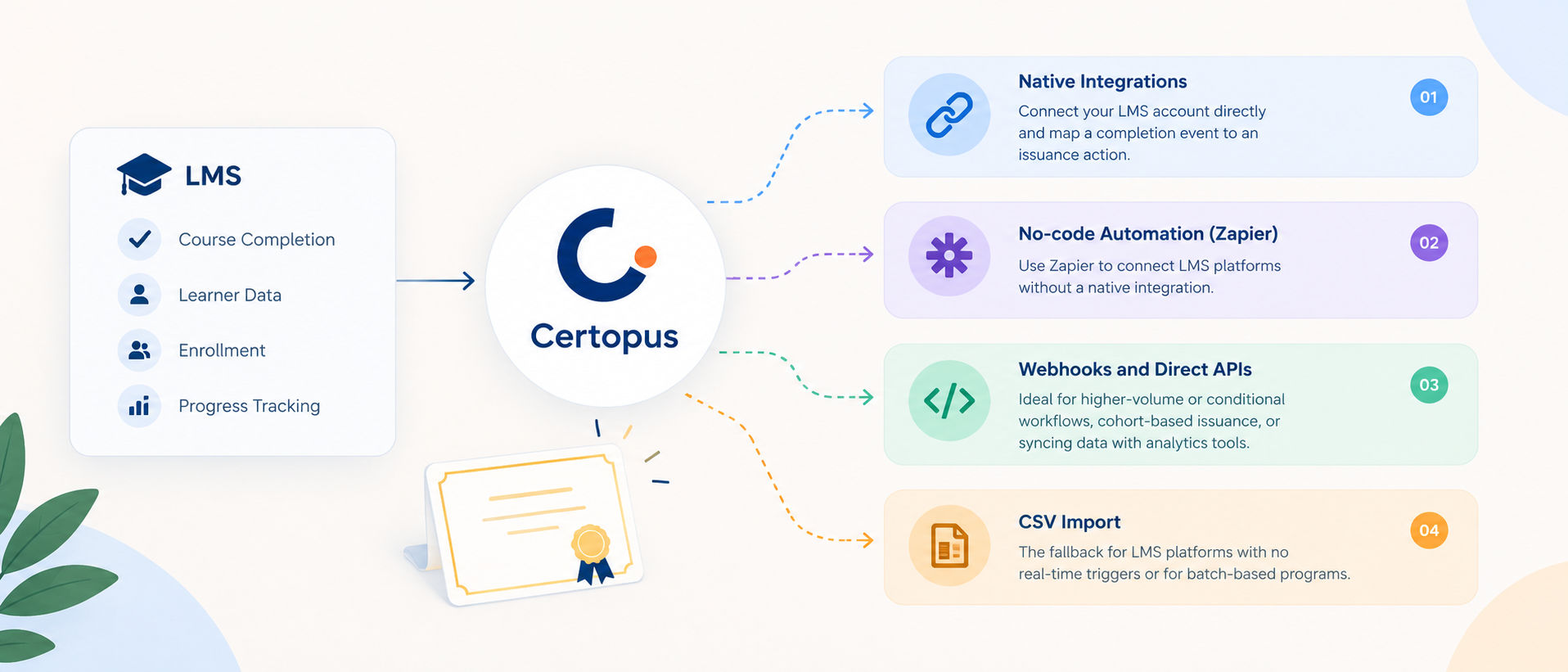
Integration usually falls into one of four tiers, and most teams don't need the most complex one to start.
Native integrations are the simplest path when they exist , you connect your LMS account directly inside the credentialing platform's dashboard and map a completion event to an issuance action. Certopus, for example, connects natively with platforms like Thinkific and Teachable this way, so a course completion in the LMS triggers certificate delivery without custom code.
No-code automation (Zapier) covers LMS platforms without a native connection. It's slower to trigger than a direct integration but requires no development work, which makes it a reasonable starting point for smaller programs.
Webhooks and direct APIs are the right tier for higher-volume or more conditional workflows cohort-based issuance, multi-step completion logic, or syncing learner data into analytics tools. This is also where integrations with tools like Mixpanel become useful, feeding credential and engagement data back into a broader reporting stack.
CSV import remains the fallback for LMS platforms with no real-time trigger support, or for programs that issue in batches rather than continuously.
Comparing the major certificate generation platforms
Each of the established players approaches LMS-linked issuance with a different emphasis:
| Platform | Core Focus | Best For |
|---|---|---|
| Certopus | B2B digital credentialing built around LMS and workflow integrations (Thinkific, Teachable), bulk issuance, and verification | Teams that want the credentialing layer to fit into an existing training or GTM stack |
| Credly | Standards-based digital badges with a large existing badge-recognition network | Enterprises already invested in Open Badges |
| Accredible | Broad LMS and course-platform integrations with detailed design controls | Certification bodies and training providers |
| Parchment | Academic transcript and credential exchange | Universities and K-12 institutions |
| Sertifier | Ease of setup for smaller teams and course creators | Course creators issuing certificates and badges at low-to-moderate volume |
| CertifyMe | Bulk certificate and badge generation, template-driven | Simpler, high-volume issuance without heavy customization |
1. Certopus

Certopus is a digital credential platform that automates certificate and badge creation, issuance, management, and verification. It integrates with 20+ LMS and learning platforms, including Moodle, Canvas, Thinkific, Blackboard, D2L Brightspace, Teachable, and Graphy, with API and automation options for custom workflows.
Organizations can automatically issue a certificate or badge when a learner completes a course, passes an assessment, or meets another defined requirement. For example, the Thinkific integration can trigger certificate issuance when a learner reaches 100% course completion.
Certopus is suitable for universities, colleges, schools, corporate L&D teams, training providers, online course creators, bootcamps, professional associations, certification bodies, nonprofits, government organizations, and event organizers.
Best suited for: Organizations that need automated LMS certificate generation, bulk issuance, customizable credentials, and easy digital verification.
2. Accredible
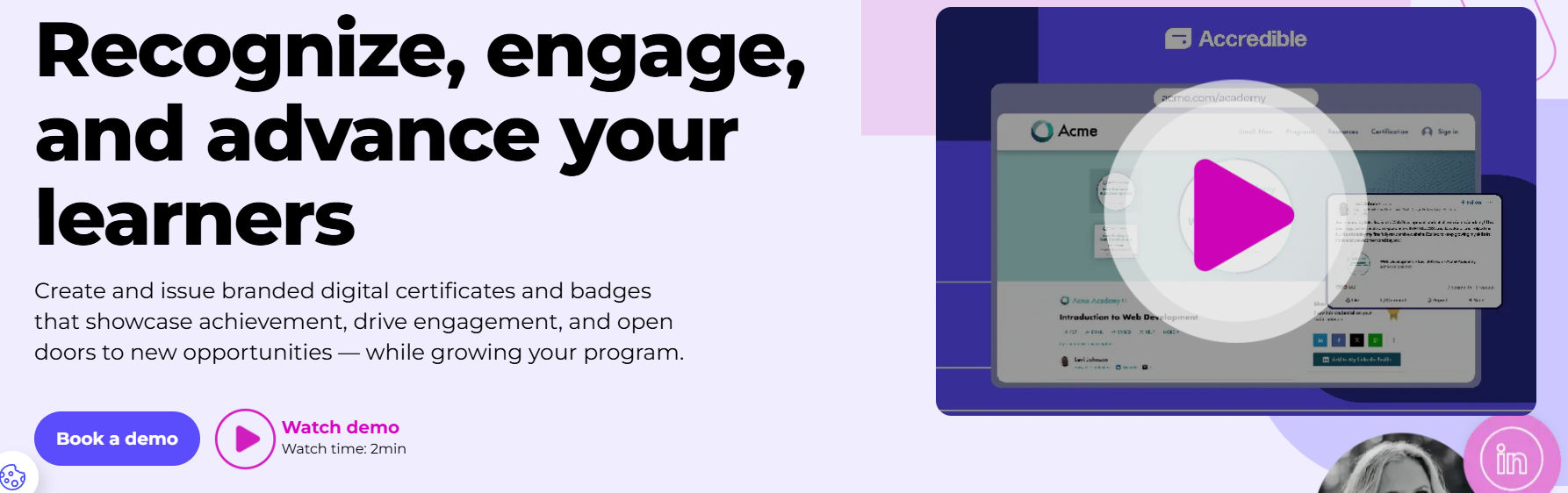
Accredible is designed around digital certificates and badges for education, training, and professional credentialing.
Its LMS capabilities make it relevant for organizations that want course completion to feed into an automated credential workflow. Canvas and Moodle are among the LMS environments associated with its integrations.
Best suited for: established education and professional certification programs that need structured credential workflows.
3. Certifier
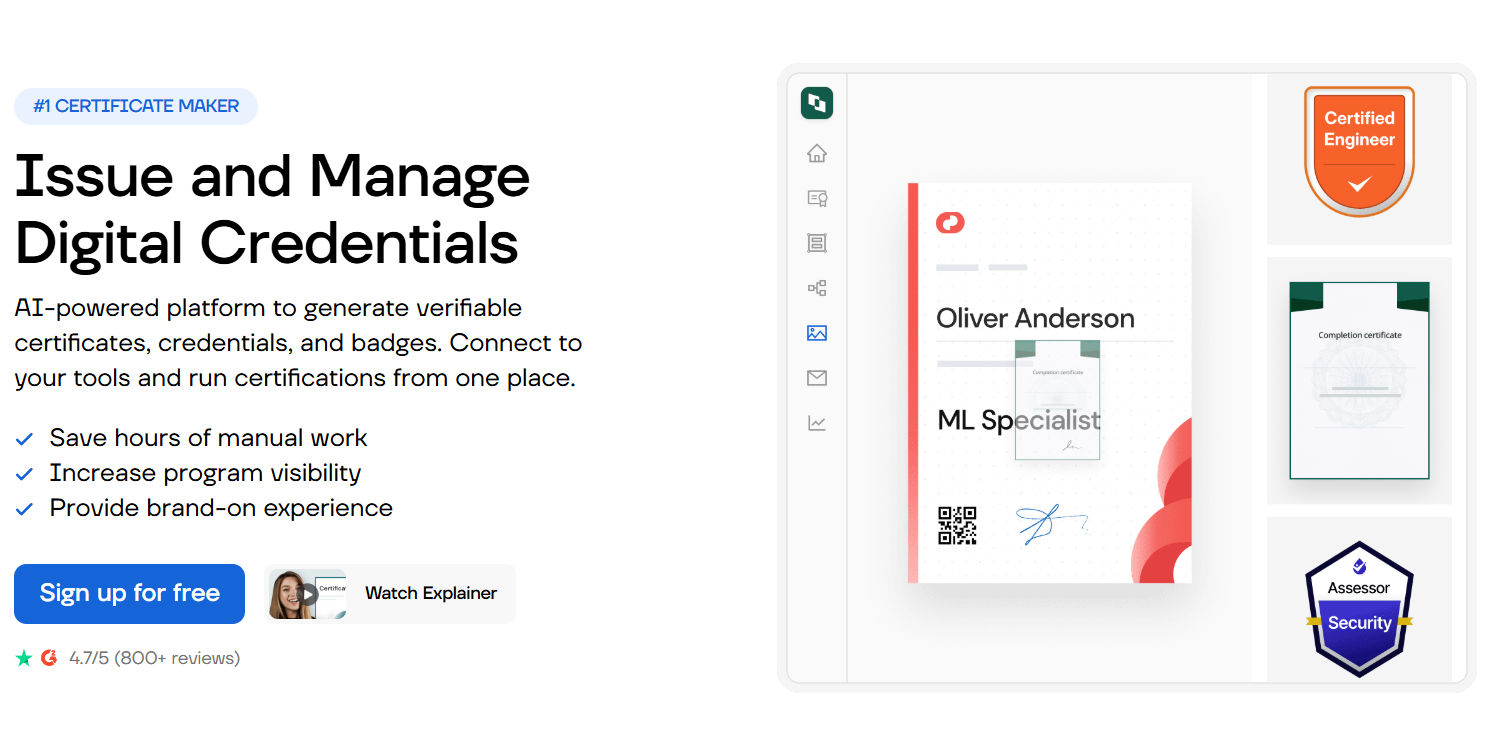
Certifier combines certificate and badge creation with automation, verification, and integrations.
It is particularly relevant for teams that want to connect learning or business systems to digital credential issuance without building an entire credentialing infrastructure themselves.
Best suited for: course creators, training providers, and smaller teams looking for an accessible digital credential workflow.
4. Credly
 Credly is widely associated with professional digital badges and enterprise credentialing.
Its value is particularly relevant when the goal extends beyond issuing a certificate and includes professional recognition, digital badge ecosystems, and credential sharing.
Best suited for: enterprise certification programs and organizations where professional badge recognition is a major requirement.
Matching the platform to your program
For corporate L&D and compliance training, the priority is usually reliable API or webhook integration with an existing LMS, bulk issuance for large cohorts, and analytics that show completion-to-credential conversion.
For online course creators and EdTech platforms, native integrations with tools like Thinkific or Teachable matter more than enterprise-scale API access, since volume is typically lower and setup speed matters more.
For universities and certification bodies, verification and long-term credential integrity tend to outweigh design flexibility — the certificate needs to hold up years after issuance, not just look polished on day one.
For associations and membership programs, dynamic personalization and social sharing (LinkedIn-ready credentials) often matter as much as the issuance mechanics, since the credential doubles as a marketing touchpoint for the recipient.
Whichever platform you shortlist, the evaluation is the same: confirm it connects to your specific LMS the way your team can realistically maintain, test the automation with a real completion event before committing, and check that the credential remains verifiable once a learner shares it outside your system.
Ready to issue verifiable credentials?
Book a personalized demo with our founder to streamline your digital credentialing workflow.

Frequently Asked Questions
Five widely used LMS platforms are Moodle, Canvas, Blackboard, D2L Brightspace, and Thinkific. The best choice depends on your use case, such as higher education, corporate training, compliance learning, or selling online courses.
You can automate certificate generation by connecting your LMS to a digital credential platform such as Certopus. When a learner completes a course, passes an assessment, or meets a defined requirement, the integration can automatically generate and deliver a personalized certificate.
The best certification platform depends on your requirements. Look for automated certificate issuance, LMS integrations, digital credential verification, bulk generation, customization, analytics, API access, and credential management. Platforms such as Certopus, is the option worth comparing.
The best AI certificate maker depends on whether you need design assistance or complete certificate automation. Certopus AI Certificate Maker helps organizations create customizable certificates while automating their issuance, making it suitable for programs that need both AI-powered certificate design and digital credential management.
The best platform for online courses with certificates is one that connects course completion directly to automated credential issuance. Look for LMS integrations, certificate automation, customizable templates, digital verification, and learner credential management. This removes the need to manually create and send certificates.
The best certificate software depends on whether you need occasional designs or automated certificate issuance at scale.Certopus is one option for organizations looking for a combination of certificate design, bulk generation, LMS integrations, automated delivery, digital verification, APIs, and credential management.